
-
Informations +968 793 793 79
-
Sales Department +968 99 26 36 46
-
United Arab Emirates +971 526 324 552
Temperature Transmitters
Industrial Temperature Transmitters for Process Monitoring & Control
Industrial temperature transmitters convert temperature signals from sensors into standardized electrical outputs for monitoring and control systems. In simple terms, they ensure accurate temperature data is transmitted to controllers, PLCs, and automation systems. As a result, they play a critical role in process stability and safety.
At UniGulfSupply, we supply reliable industrial temperature transmitters for factories, HVAC systems, and process industries across Oman & UAE. In addition, these devices provide high accuracy, stable signal output, and long-term reliability in demanding environments.
Temperature transmitters are commonly installed with PT100 Sensors, Controllers, and Industrial Control Relays. Consequently, they form an essential part of industrial monitoring and automation systems.
Types of Temperature Transmitters
This category typically includes:
- head-mounted transmitters
- DIN rail temperature transmitters
- field-mounted transmitters
- programmable transmitters
- multi-input temperature transmitters
Each type supports different installation needs. For example, head-mounted units fit directly into sensor housings. In contrast, DIN rail models integrate easily داخل control panels. Additionally, programmable units allow flexible configuration for various applications.
Why Temperature Transmitters Are Important
Accurate temperature measurement is essential in industrial processes. However, raw sensor signals are often weak or unstable over long distances.
Using temperature transmitters helps you:
- improve signal accuracy
- reduce electrical interference
- enable long-distance transmission
- support automation systems
- enhance process control
Moreover, stable temperature data allows better decision-making and system performance.
Typical Applications
Temperature transmitters are widely used in:
- HVAC and building automation
- process industries
- food and beverage production
- water treatment systems
- power generation plants
- industrial machinery
Because temperature directly affects system performance, reliable monitoring is essential in these applications.
How Temperature Transmitters Work
A typical process includes:
- sensor detects temperature (e.g., PT100)
- transmitter converts signal to standard output (4–20 mA or similar)
- signal is sent to controller or PLC
- system adjusts operation based on temperature
As a result, operators receive accurate and stable readings for control and monitoring.
Selecting the Right Temperature Transmitter
When selecting a transmitter, consider:
- sensor compatibility (RTD, thermocouple)
- output signal type
- mounting style
- accuracy requirements
- environmental conditions
For instance, harsh environments require rugged, field-mounted units. On the other hand, panel installations benefit from compact DIN rail models.
FAQs
What does a temperature transmitter do?
It converts sensor signals into standardized outputs for monitoring and control systems.
What is the difference between a sensor and a transmitter?
A sensor detects temperature, while a transmitter converts and sends the signal.
Are these devices used with PLCs?
Yes. They commonly send signals directly to PLCs and controllers.
What output signals are used?
Most transmitters use 4–20 mA or similar industrial standards.
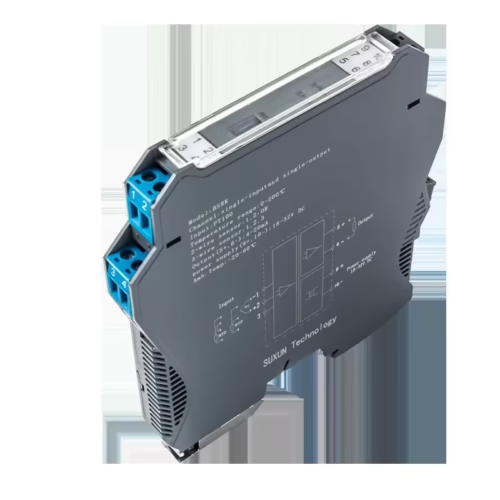
Universal Temperature Transmitter (PT100 / K-Type) 4–20mA / 0–10V / RS485
Original price was: ر.ع.188.000.ر.ع.179.800Current price is: ر.ع.179.800.