-
Informations +968 793 793 79
-
Sales Department +968 99 26 36 46
-
United Arab Emirates +971 526 324 552
Control Relays
Industrial Control Relays for Automation & Control Panels
Industrial control relays are electrically operated switches that control circuits in automation and industrial systems. They allow low-power signals to manage higher-power loads safely and efficiently. As a result, they play a central role in panel logic and system coordination.
Modern control panels rely on these relays to automate switching, isolate circuits, and improve safety. Unlike overload relays, which protect motors, these devices focus on signal switching and circuit management. Therefore, engineers use them widely in automation, machinery, and process control systems.
At UniGulfSupply, we supply durable industrial control relays designed for control panels across Oman & UAE. In addition, our range supports reliable switching, stable coil performance, and long electrical life. Compact designs also allow easy installation in densely wired panels. For this reason, engineers depend on them in structured automation layouts.
Engineers often integrate these relays with Auxiliary Relays, Timer Relays, and Relays & Contactors. Consequently, they form an essential part of coordinated control architecture.
Products Included in This Category
This category typically includes:
- Electromagnetic control relays
- Plug-in relays with socket bases
- DIN rail mounting relays
- Multi-pole general-purpose relays
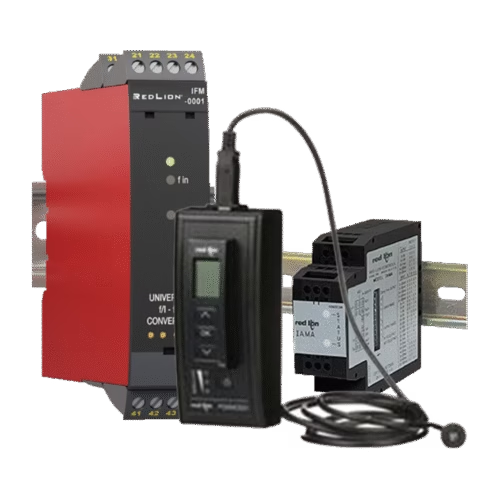
- Interface relays for signal isolation
Each type supports precise switching and dependable electrical contact. Moreover, modular designs simplify replacement and maintenance.
Why Industrial Control Relays Are Important
Industrial systems require coordinated signal control. However, without proper relay switching, automation logic can become unreliable or unsafe. For example, direct switching of higher loads through control devices may reduce equipment lifespan.
Using high-quality control relays helps you:
- Isolate control circuits
- Expand switching capacity
- Improve system reliability
- Support automation logic
- Reduce load on control devices
Therefore, these relays remain fundamental components in industrial electrical design.
Typical Applications
Technicians use these relays in:
- Control panels
- PLC interface systems
- Motor starter assemblies
- Process automation systems
- Machine control cabinets
Because modern systems require safe signal separation, relay-based switching improves flexibility and protection. In many cases, it also simplifies troubleshooting and system expansion.
System Integration & Installation
Installers typically mount relays on DIN rails or plug them into socket bases. In addition, proper wiring using Wire Termination & Identification Accessories ensures secure connections and easier maintenance.
For safe cable entry into panels, Cable Glands & Entry Sealing Systems help maintain enclosure protection and prevent environmental ingress.
Selecting the Right Control Relay
When selecting a relay, consider:
- Coil voltage rating
- Contact configuration (SPDT, DPDT, etc.)
- Number of poles
- Mounting type
- Switching capacity
For example, plug-in relays simplify maintenance, while DIN rail models suit structured panel layouts. Additionally, choosing the correct contact rating ensures long-term reliability.
FAQs
What is a control relay used for?
It switches electrical circuits using a low-power signal to control higher-power loads.
Are control relays the same as overload relays?
No. Control relays manage signal switching, whereas overload relays protect motors from excessive current.
Can control relays be used with PLC systems?
Yes. They are commonly used as interface relays between PLC outputs and field devices.