-
Informations +968 793 793 79
-
Sales Department +968 99 26 36 46
-
United Arab Emirates +971 526 324 552
PT100 Sensors
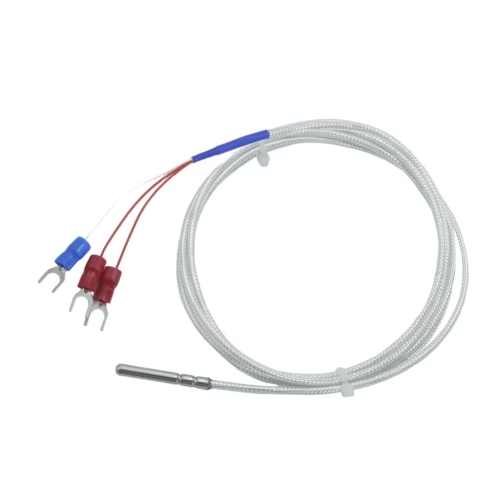
PT100 Sensors for Precision Industrial Temperature Measurement
PT100 sensors measure temperature using resistance changes in a platinum element. In simple terms, resistance increases as temperature rises. As a result, control systems calculate temperature accurately and consistently.
Engineers choose these sensors when applications require stable and repeatable readings. Unlike thermocouples, which generate small voltage signals, platinum RTDs provide highly linear resistance variation. Therefore, they deliver excellent accuracy across a wide temperature range.
At UniGulfSupply, we supply high-quality PT100 sensors for industrial applications across Oman & UAE. In addition, our range includes probe, surface, and immersion configurations. Moreover, stainless-steel construction protects the sensing element in demanding environments. For this reason, industries rely on these sensors in critical temperature control systems.
These sensors typically operate with Industrial Temperature Transmitters, Controllers, and Dataloggers. Consequently, they form part of a complete and reliable monitoring solution.
Types:
This category typically includes:
- probe-type temperature sensors
- surface-mounted RTD sensors
- immersion temperature probes
- high-temperature platinum sensors
Each type suits specific applications. For example, immersion probes monitor liquids in tanks and pipelines. Similarly, surface-mounted sensors measure external pipe or equipment temperature. In addition, high-temperature models withstand harsh industrial conditions.
Why these Sensors Are Important!
Accurate temperature measurement is essential for both equipment protection and product quality. However, unreliable sensing can lead to overheating or process instability.
Using PT100 sensors helps you:
- maintain precise temperature control
- improve process consistency
- protect industrial equipment
- support automation accuracy
- reduce measurement drift
Moreover, stable readings improve system efficiency and reduce maintenance risks.
Typical Applications
PT100 sensors are widely used in:
- HVAC systems
- boilers and furnaces
- food processing lines
- water treatment facilities
- chemical processing plants
Because these industries require accurate and traceable temperature data, PT100 sensors support both operational performance and compliance standards.
How PT100 Sensors Work
A typical process includes:
- platinum element detects temperature change
- resistance varies proportionally
- signal is transmitted to a controller or PLC
- system adjusts operation based on readings
In many cases, technicians use Industrial Temperature Transmitters to convert resistance into stable output signals for long-distance transmission.
Selecting the Right PT100 Sensor
When selecting a sensor, consider:
- temperature range
- probe length and diameter
- cable type
- accuracy class (Class A or B)
- environmental protection rating
For instance, Class A sensors provide higher precision. On the other hand, Class B sensors suit general industrial use. Additionally, correct probe length ensures accurate immersion and measurement.
FAQs
What does PT100 mean?
It refers to a platinum resistance temperature sensor with 100 ohms at 0°C.
Are PT100 sensors accurate?
Yes. They offer excellent stability and linear response across a wide range.
Do PT100 sensors require a transmitter?
Often yes. Transmitters convert resistance signals into standardized outputs for reliable transmission.
Where are PT100 sensors commonly used?
They are widely used in HVAC, manufacturing, water treatment, and process automation systems.