
-
Informations +968 793 793 79
-
Sales Department +968 99 26 36 46
-
United Arab Emirates +971 526 324 552
Data Loggers
Data Loggers for Industrial Monitoring & Performance Recording
Industrial Data loggers record and store measurement values over time for monitoring and analysis. In simple terms, they capture signals from connected sensors and save them in internal memory. As a result, engineers can review trends, identify irregularities, and improve process performance.
Technicians connect data loggers to temperature sensors, transmitters, and other monitoring devices. Unlike controllers, which actively regulate systems, these devices focus on recording information for later evaluation. Therefore, they support long-term diagnostics and compliance reporting rather than direct control.
At UniGulfSupply, we supply reliable data loggers for industrial applications across Oman & UAE. In addition, our range includes portable and panel-mounted options. Moreover, many models support multi-channel input for broader monitoring coverage. For this reason, industries rely on them for structured data collection and documentation.
Data loggers commonly operate alongside
→ [INTERNAL LINK: PT100 Sensors]
→ [INTERNAL LINK: Temperature Transmitters]
→ [INTERNAL LINK: Controllers]
Consequently, they complete a comprehensive monitoring system.
Types of Data Loggers Available
This category includes:
Temperature data loggers
Multi-channel recording units
Portable inspection loggers
Panel-mounted monitoring devices
USB-enabled recording units
For example, portable models allow technicians to collect field data during inspections. Similarly, panel-mounted versions support continuous factory monitoring. Additionally, USB-enabled units simplify data export and reporting.
Why Data Loggers Are Important
Industrial processes require accurate historical records. Without reliable data storage, engineers cannot analyze long-term performance or verify compliance. As a result, troubleshooting becomes slower and less precise.
High-quality data loggers help you:
track temperature and process trends
detect early performance deviations
support preventive maintenance planning
maintain regulatory documentation
improve operational visibility
Therefore, they strengthen process reliability and quality assurance strategies.
Typical Applications
Engineers install data loggers in:
cold storage facilities
HVAC systems
food processing plants
pharmaceutical environments
water treatment operations
Because many industries must maintain historical temperature records, these devices provide traceable and structured data. In many cases, teams export stored information for audits and technical reports.
Selecting the Right Data Logger
When selecting data loggers, consider:
number of input channels
sensor compatibility
memory capacity
data export options
power supply type
For instance, multi-channel units suit complex monitoring systems. In contrast, single-channel portable devices support basic inspections. Additionally, higher memory capacity allows longer recording intervals without interruption.
FAQs
What does a data logger do?
It records measurement values over time for monitoring and analysis.
Can data loggers work with PT100 sensors?
Yes. In fact, many models accept RTD inputs directly or through transmitters.
Do data loggers control equipment?
No. They record data. Controllers, however, regulate system operation.
Where do industries use data loggers?
Industries use them in HVAC, food production, environmental monitoring, and storage facilities.
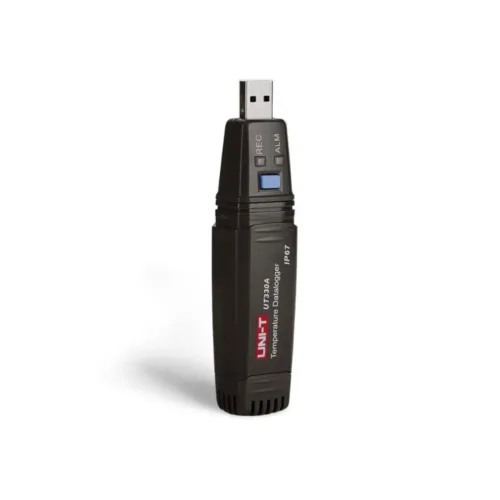
USB Temperature Datalogger | IP67 (UNIT-T)
Original price was: ر.ع.28.500.ر.ع.28.000Current price is: ر.ع.28.000.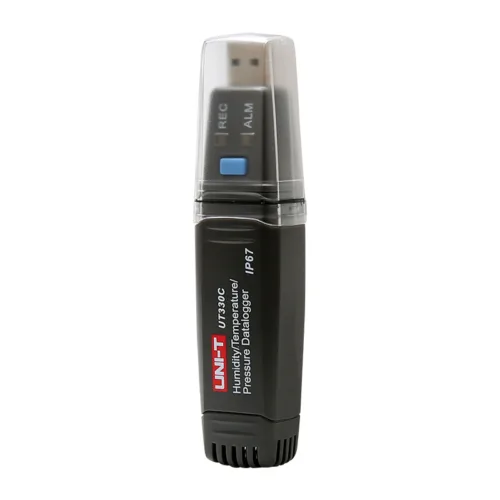
UT330B | USB Series Dataloggers
Original price was: ر.ع.48.500.ر.ع.42.500Current price is: ر.ع.42.500.