-
Informations +968 793 793 79
-
Sales Department +968 99 26 36 46
-
United Arab Emirates +971 526 324 552
Controllers
Controllers for Industrial Process Control & Automation
Controllers regulate industrial processes by monitoring input signals and adjusting outputs accordingly. In simple terms, they compare measured values with a setpoint and take corrective action when needed. As a result, they maintain stable and accurate system operation.
Engineers use controllers to manage temperature, pressure, flow, and other critical process variables. Unlike data loggers, which record information for analysis, these devices actively control equipment in real time. Therefore, they play a direct role in maintaining operational stability.
At UniGulfSupply, we supply reliable controllers for industrial automation across Oman & UAE. In addition, our range includes panel-mounted and digital process units. Moreover, user-friendly interfaces simplify configuration and monitoring. For this reason, industries depend on them for consistent and responsive control.
Controllers typically operate together with
→ PT100 Sensors
→ Temperature Transmitters
→ Data Loggers
Consequently, they form the core of structured automation systems.
Types of Controllers Available
This category includes:
Temperature controllers
PID controllers
Digital process controllers
Multi-function control units
Panel-mounted controllers
For example, PID controllers calculate proportional, integral, and derivative adjustments to maintain tight control. Similarly, digital process units manage multiple parameters in compact installations. Additionally, panel-mounted models integrate neatly into control cabinets.
Why Controllers Are Important
Industrial systems require precise and stable regulation. Without proper control devices, processes may drift outside safe operating limits. As a result, equipment efficiency decreases and product quality may suffer.
High-quality controllers help you:
maintain accurate setpoint regulation
improve process stability
reduce energy waste
protect equipment from fluctuations
support automation integration
Therefore, they serve as essential components in modern control panels.
Typical Applications
Technicians install controllers in:
HVAC systems
boilers and heating units
food processing lines
water treatment plants
manufacturing equipment
Because many industrial processes require continuous adjustment, controllers provide real-time regulation. In many cases, engineers integrate them with PLC systems for expanded automation capability.
Selecting the Right Controller
When selecting controllers, consider:
control type (On/Off or PID)
input signal compatibility
output configuration
display and interface type
panel mounting size
For instance, PID units suit applications requiring precise temperature regulation. In contrast, simple on/off models support basic control tasks. Additionally, selecting compatible input signals ensures accurate system response.
FAQs
What does a controller do?
It monitors input signals and adjusts outputs to maintain a set process value.
What is a PID controller?
It uses proportional, integral, and derivative calculations to regulate process variables precisely.
How do controllers differ from data loggers?
Data loggers record information. Controllers, however, actively regulate equipment in real time.
Can controllers work with PT100 sensors?
Yes. In fact, many models accept RTD inputs directly or through transmitters.
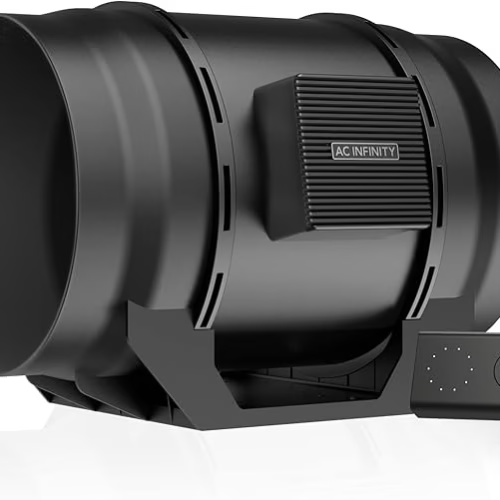
AC Infinity A8 – 8″ Inline Duct Fan Speed Controller
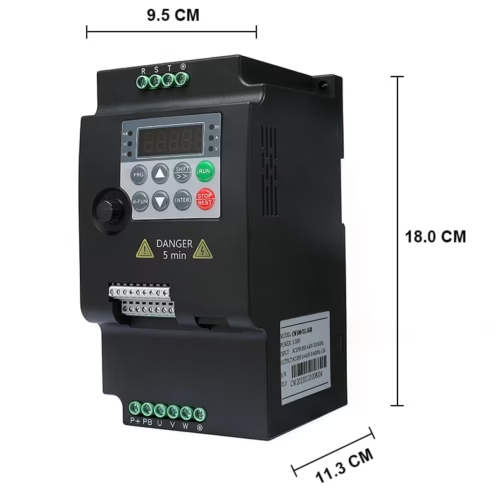
Inverter Motor Controller | VFD Inverter 2.2kW
Original price was: ر.ع.64.000.ر.ع.56.000Current price is: ر.ع.56.000.
Motor Speed Controller | JD1A-40
Price range: ر.ع.75.000 through ر.ع.120.000Select options This product has multiple variants. The options may be chosen on the product page