-
Informations +968 793 793 79
-
Sales Department +968 99 26 36 46
-
United Arab Emirates +971 526 324 552
Terminal Blocks
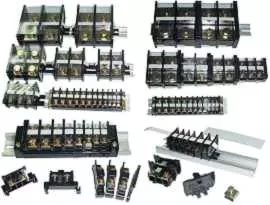
Terminal Blocks for Safe & Organized Electrical Connections
Industrial Terminal blocks provide a secure and structured way to connect electrical conductors inside control panels and enclosures. They ensure clear circuit separation while improving safety and reliability. As a result, technicians can organize wiring efficiently and reduce troubleshooting time.
At UniGulfSupply, we supply high-quality terminal blocks suitable for control panels, machinery wiring, and industrial installations across Oman & UAE. These components simplify panel assembly and support long-term system performance.
Installers commonly mount terminal blocks onto Mounting & DIN Rail Systems. In addition, they install them inside Waterproof Enclosures & Junction Boxes to protect wiring from dust and moisture.
Understanding Terminal Blocks in Electrical Panels
Terminal blocks act as connection points where electrical conductors are safely joined without direct splicing. Instead of twisting wires together, each conductor terminates individually, which improves safety and simplifies maintenance.
Moreover, structured terminal layouts help technicians quickly identify circuits. Therefore, panel builders rely on terminal blocks to create clean, professional wiring systems.
Types of Terminal Blocks
Different applications require different connection methods. This category includes:
- Screw-type terminal blocks
- Spring clamp terminal blocks
- Feed-through terminal blocks
- Earth (ground) terminal blocks
- Multi-level terminal blocks
- End plates, partitions, and accessories
Each type supports safe conductor termination while maintaining organized panel layouts.
For DIN-mounted solutions, explore DIN Rail Terminal Blocks.
Why Terminal Blocks Are Important
Modern electrical systems require organized and reliable connections. Without proper termination, loose wiring can lead to overheating, faults, or system failure.
Using terminal blocks helps you:
- create structured wiring layouts
- ensure secure conductor connections
- simplify circuit identification
- improve maintenance efficiency
- reduce electrical faults
Consequently, they are essential for safe and professional installations.
How Terminal Blocks Work
Terminal blocks clamp conductors using screw or spring mechanisms. Technicians strip the wire, insert it into the terminal, and secure it firmly. The block then maintains strong electrical contact while preventing wire movement.
Additionally, modular designs allow easy expansion or modification of wiring systems. Because of this flexibility, terminal blocks suit both small and complex installations.
In addition, when cables enter the panel, installers secure them using Cable Glands before terminating conductors on terminal blocks, ensuring both protection and organized wiring.
Typical Applications
Terminal blocks are widely used in:
- industrial control panels
- motor control systems
- building automation systems
- HVAC control panels
- pump and irrigation systems
- machinery wiring
Because these systems involve multiple circuits, structured wiring becomes essential for safety and efficiency.
Selecting the Right Terminal Block
Choosing the correct terminal block depends on several factors:
- conductor size and type
- voltage and current rating
- connection method (screw or spring)
- panel layout requirements
- vibration or environmental conditions
For example, spring clamp terminals suit high-vibration environments, while screw terminals offer strong mechanical connections.
Improve Panel Organization with Proper Identification
Clear identification is essential for safe maintenance. Therefore, technicians often combine terminal blocks with Cable Identification Systems and labeling tools.
Using proper labeling ensures every conductor remains traceable, which significantly reduces troubleshooting time.
Applications in Oman & UAE
Across Oman & UAE, electrical contractors, panel builders, and maintenance teams rely on terminal blocks for structured wiring in industrial and commercial projects.
These components help maintain safe, organized, and scalable electrical systems across factories, buildings, and infrastructure installations.
Frequently Asked Questions
What is a terminal block used for?
It connects and organizes electrical conductors inside panels and enclosures safely.
What is the difference between screw and spring terminal blocks?
Screw terminals use mechanical tightening, while spring terminals use clamp pressure for faster installation.
Can terminal blocks handle high current?
Yes, provided you select a block rated for the required current and conductor size.
Do terminal blocks improve maintenance?
Yes. They allow technicians to isolate and test circuits quickly without disturbing other connections.
Are terminal blocks reusable?
Yes, most types can be reused if they remain undamaged and within rating limits.