
-
Informations +968 793 793 79
-
Sales Department +968 99 26 36 46
-
United Arab Emirates +971 526 324 552
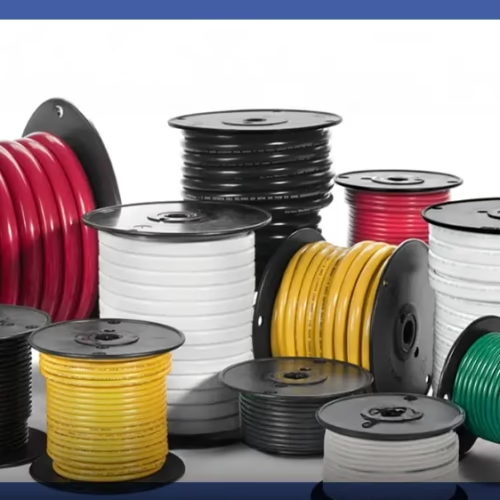
Industrial Electrical Cables
Industrial Electrical Cables for Power and Control Applications
Industrial electrical cables transmit power and control signals between equipment, panels, and machinery. They ensure stable voltage supply and reliable signal transmission. As a result, systems operate safely and efficiently, even in demanding environments.
At UniGulfSupply, we supply dependable industrial electrical cables for contractors, panel builders, and maintenance teams across Oman & UAE. These cables support generators, HVAC systems, automation setups, and building services. Therefore, technicians can complete installations with greater reliability and reduced downtime.
For secure conductor termination, see cable lugs & electrical terminals . In addition, installers often combine cables with terminal blocks & connectors to achieve organized panel wiring.
Products Included in This Category
This category typically includes:
- control cables (shielded and unshielded – e.g., LIYCY)
- rubber cables (H07RN-F, H05RN-F, H03RN-F)
- flexible multicore cables
- PVC industrial cables
- equipment wiring cables
Installers secure cable entry using cable glands & accessories (link). Moreover, they protect routed wiring with cable protection & routing products (link).
Why Industrial Electrical Cables Matter
Industrial environments expose wiring to vibration, heat, and moisture. If you select the wrong cable type, insulation can degrade and voltage drop may increase. Consequently, equipment performance becomes unstable.
However, choosing the correct cable helps you:
- maintain stable power delivery
- reduce voltage drop
- prevent insulation damage
- protect connected equipment
- improve long-term reliability
In addition, correct sizing supports safer installations and easier inspections.
Typical Applications
Professionals use these cables in:
- electrical control panels
- motor control centers (MCC)
- generators and transfer systems
- machinery wiring
- HVAC installations
- factory automation systems
Because these systems often run continuously, they require properly rated cables. For example, automation setups rely on shielded control cables to prevent signal interference.
How Industrial Cables Work
Industrial cables contain copper conductors surrounded by insulation and protective sheathing. Installers route them through trays or conduits and secure them using glands. Then, they strip insulation and terminate conductors with lugs or terminal blocks.
As a result, the system achieves both strong mechanical connection and stable electrical performance.
How to Select the Right Cable
Before selecting a cable, consider:
- voltage rating (e.g., 0.6/1kV)
- conductor size (mm² or AWG)
- number of cores
- shielding requirements
- installation environment
- flexibility needs
For instance, portable equipment requires flexible rubber cables, while control panels typically use shielded multicore cables.
For maintenance and labeling, see cable identification products (link).
Related Electrical Components
These cables are commonly used with:
- cable lugs & electrical terminals
- cable protection & routing
- control panel components
- cable identification products
Frequently Asked Questions
What is a control cable?
A control cable carries low-current signals between devices and control panels.
When should I use rubber cables like H07RN-F?
Use them in outdoor or mobile applications because they resist water and remain flexible.
Do I always need shielding?
Not always. However, shielding helps in environments with electrical interference.
Where are these cables used?
They connect panels, machinery, generators, and building systems.
Industrial Electrical Cables in Oman
UniGulfSupply supplies reliable industrial electrical cables for contractors and industrial users across Oman & UAE, ensuring safe and efficient power and control systems.