
-
Informations +968 793 793 79
-
Sales Department +968 99 26 36 46
-
United Arab Emirates +971 526 324 552
Relays
Industrial Relays for Electrical Control & Automation Systems
Industrial relays are switching devices that allow a low-power control signal to operate a higher-power electrical circuit. They act as an interface between control components and electrical loads. In most control panels, relays perform logic control, signal isolation, and equipment protection.
At UniGulfSupply, we supply reliable industrial relays suitable for automation panels, machinery, and building systems across Oman & UAE. These relays help control motors, alarms, lighting, and automated processes safely and efficiently.
Relays receive signals from push buttons, switches, and sensors. They then activate contactors, alarms, or other equipment. Therefore, sensitive control devices can operate heavy electrical loads without damage.
Types of Relays Available
This category typically includes:
Electromechanical relays
Plug-in control relays
Miniature relays
Power relays
Interface relays
Timer relays
Monitoring relays
Solid state relays (SSR)
Relay sockets and bases
These relays operate together with Industrial Push Buttons and Industrial Sensors.
They commonly control Contactors & Motor Starters and integrate with PLC & Automation Controllers.
Why Relays Are Important
Control systems require safe signal separation. Relays provide electrical isolation between control circuits and power circuits.
Using relays allows systems to:
Control motors safely
Expand PLC output capacity
Protect controllers from high voltage
Trigger alarms and indicators
Sequence machine operations
As a result, automation systems become safer and more reliable. Additionally, maintenance becomes easier because relays are replaceable components.
Typical Applications
Industrial relays are widely used in:
Motor control panels
Pump control systems
Generator panels
HVAC systems
Conveyor systems
Lighting control systems
Alarm and safety circuits
Industrial automation machines
Because relays switch quickly and reliably, they are essential in both manual and automatic control circuits.
How a Relay Works
Basic control sequence:
Sensor or push button sends signal
Relay coil energizes
Relay contacts change state
Contactor or alarm activates
This allows a small control signal to operate large equipment safely.
Choosing the Correct Relay
When selecting a relay, consider:
Coil voltage (12V, 24V, 110V, 230V)
Contact rating (current capacity)
Number of contacts (SPDT, DPDT)
Mounting type (plug-in or DIN rail)
Switching frequency
Environmental conditions
For example, interface relays protect PLC outputs. Meanwhile, solid state relays are suitable for high switching frequency applications.
FAQs
What is the difference between a relay and a contactor?
A relay controls smaller loads and signals. A contactor is designed to switch high-power equipment such as motors.
Why use a relay with a PLC?
Relays protect PLC outputs and allow the controller to operate higher-current devices safely.
What is a solid state relay?
It is an electronic switching device with no moving contacts, suitable for fast and silent operation.
Do relays need a socket?
Plug-in relays use sockets for easy replacement and maintenance.
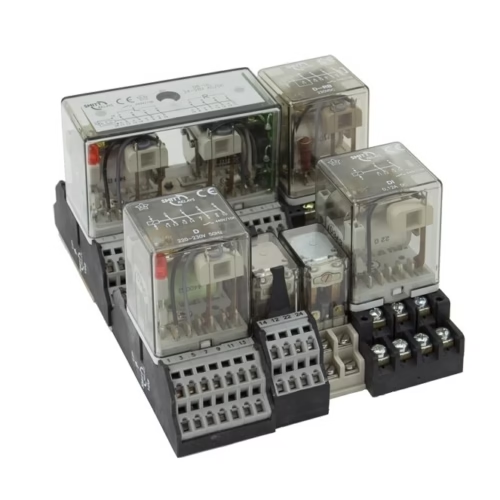
Auxiliary Relays (1)
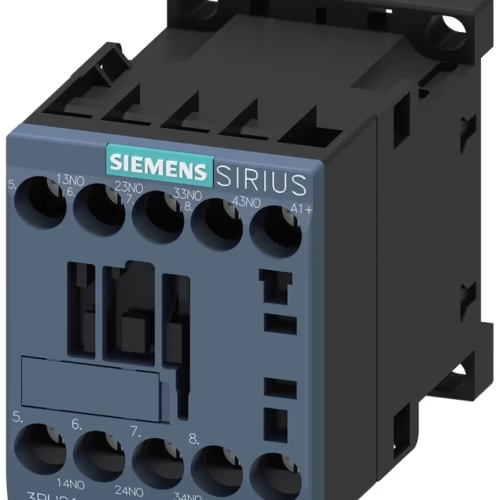
Siemens 3RH21401KB40 – 10A 24V DC 4NO BUILT IN SUPRESSOR DIODE
Original price was: ر.ع.85.000.ر.ع.83.500Current price is: ر.ع.83.500.