-
Informations +968 793 793 79
-
Sales Department +968 99 26 36 46
-
United Arab Emirates +971 526 324 552
Resistors
Resistors for Industrial Control, Power Management & Circuit Protection
Resistors are essential electronic components used to control current, manage voltage, and dissipate power in electrical circuits. They play a key role in ensuring stable and safe operation across industrial and automation systems.
At UniGulfSupply, we supply high-performance resistor solutions designed for demanding environments. In many applications, these components work alongside Electronic Components and Control Power Supplies, helping users build reliable and efficient systems. In addition, we offer high-power and adjustable options suitable for industrial load control.
Types:
Different resistor types support a wide range of industrial applications. For example:
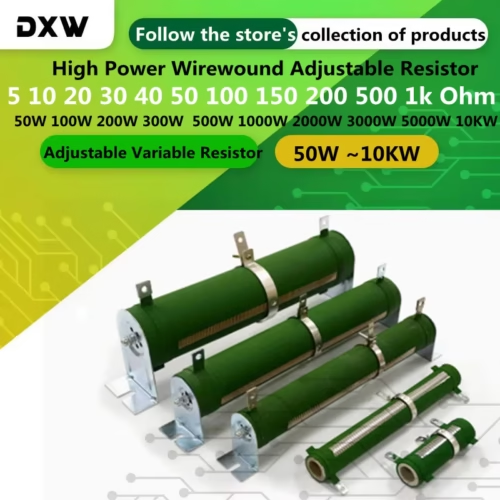
- High Power Resistors – Designed for heavy-duty load handling (50W to 10kW and above)
- Adjustable Resistors – Allow variable resistance for tuning and control
- Wirewound Resistors – Provide durability and high heat resistance
- Fixed Resistors – Maintain constant resistance in circuits
- Braking Resistors – Used in motor control and energy dissipation
As a result, users can select the right type based on performance and application needs.
Why these Are Important!
These components are critical for circuit stability and protection. First, they regulate current flow and prevent overload conditions. In addition, they help control voltage levels across different parts of a system. Moreover, they dissipate excess energy safely, which protects sensitive equipment.
When integrated with Automation Components and control systems, they contribute to reliable and efficient operation.
Applications
These components are widely used in:
- Industrial automation systems
- Motor control and braking systems
- Power distribution and load testing
- Control panels and electrical assemblies
- HVAC and energy systems
- Machinery and equipment design
Therefore, they are essential for both circuit design and power management.
Selection Guide
To choose the right resistor, consider the following:
- Power Rating – Wattage capacity for load handling
- Resistance Value – Required ohmic range (e.g., 5Ω–1kΩ)
- Adjustability – Fixed or variable resistance
- Thermal Performance – Heat dissipation capability
- Application Type – Control, braking, or load testing
- Integration – Compatibility with Electronic Components
By evaluating these factors, users can ensure safe and optimal performance.
Industry Use
In industrial environments, these components handle high loads and support stable circuit operation. Meanwhile, in automation systems, they enable precise control and energy management. As systems demand higher efficiency, reliable resistor solutions become increasingly important.
Product Bridge
Our range includes:
- High power adjustable resistors (50W–10kW)
- Wirewound and fixed resistors
- Industrial braking resistors
- Load and power control resistors
These products integrate seamlessly with Control Power Supplies and automation systems, supporting complete electrical solutions.
FAQ
Q1: What are resistors used for?
They control current flow and manage voltage within electrical circuits.
Q2: What is a high power resistor?
It is designed to handle large electrical loads and dissipate heat safely.
Q3: Are adjustable resistors useful in industrial systems?
Yes, they allow fine-tuning of resistance for precise control.
Q4: How do I select the right resistor?
Consider power rating, resistance value, and application requirements.
Q5: Where are these components commonly used?
They are used in automation systems, motor control, and power circuits.
Industrial Supply Section
UniGulfSupply supplies high-quality electronic components across Oman and the UAE. In addition to resistors, we offer Electronic Components, Control Power Supplies, and automation products for complete system solutions.
Resistors remain fundamental to modern electrical and automation systems. As industries require better control and energy management, these components continue to play a critical role in ensuring safe, stable, and efficient operations.